
Part of retirement, and indeed part of growing older, is finding time to remember the things that rarely occupied your thoughts when you were younger and busy with work. Sometimes those memories arrive unexpectedly, carried by an old photograph, a familiar song, or in my case, a guitar that once belonged to my father.
For most of my life, I thought I knew what my father’s guitar was. It was an Ibanez copy of a Chet Atkins 1962 Gretsch Country Gentleman. Or at least that’s what I thought.
The guitar came into our family through my father, who bought it from Taks Home Furnishers in Golden, British Columbia. In those days, furniture stores often sold all sorts of things. If someone traded in a guitar or if a used instrument found its way through town, it might end up leaning against a wall beside a living room suite.
My father played for local dances throughout the Columbia Valley and beyond. Golden, Brisco, Parsons, and sometimes Vernon. The guitar traveled with him, helping provide the soundtrack to community halls, celebrations, and countless evenings that have now faded into memory. To me, it was simply Dad’s guitar.
Years later, after inheriting it, I became curious about its history and like many family heirlooms, the more I looked at it, the more questions I had. How old was it? Where had it been made? Was it really a Country Gentleman? The search quickly became an adventure.
I found references to old Japanese guitars. I dug through catalog archives. I read discussions written by dedicated collectors who could seemingly identify the year of a guitar by the shape of a tuning key or the placement of a screw. I became convinced I was chasing the history of an obscure Ibanez model, possibly something connected to the Gretsch-inspired designs of the late 1960s.
The deeper I dug, the stranger things became. Nothing quite matched. Parts of the guitar seemed to belong to one story, while other parts belonged to another. Then came the breakthrough.
Photographs revealed something I had completely overlooked. The neck clearly carried an Ibanez logo, but the body told a different story. What I eventually learned was that the guitar appears to be a Frankin-hybrid. The neck is genuine Ibanez, and the body appears to be from a Harmony hollow-body guitar built in Chicago (circa 1964). Somewhere in the distant past, those two pieces found each other and became a single instrument.
The guitar didn’t match any catalog because it wasn’t a catalog guitar, it was unique.
Whether the modification was made by a repair shop, a previous owner, or someone whose name has long been forgotten, I will never know. In fact, my father purchased it exactly as it is. By the time it reached him in Golden, British Columbia, it was already living its second life.
Oddly enough, discovering that it wasn’t a “pure” example of some collectible model didn’t diminish it in my eyes; quite the opposite.
A factory-original guitar is interesting, but a one-of-a-kind survivor is a story.
Recently, I found an old photograph of my father sitting with the guitar in his hands. There is an amplifier beside him and the instrument resting comfortably across his lap. It is not a collector’s photograph. It is not a showroom advertisement; it is a moment, a real evening from a real life.
Looking at that picture now, I find myself paying less attention to the guitar and more attention to the man holding it. The mystery was never really about identifying wood, hardware, or serial numbers: It was about reconnecting with a small piece of my father’s world. A world of local dances, country roads, community halls, and music shared with friends and neighbours.
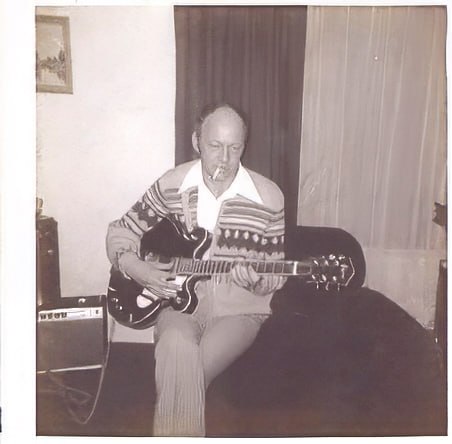
Its neck came from one place. Its body came from another. Its story was written somewhere in between.
And somehow, after decades of travel, music, repairs, and mystery, it found its way into my bedroom closet. Not bad for a guitar bought at a furniture store in Golden in the Winter of 1968.
Be First to Comment